
Short answer
Yes. Most interiors are painted with the family at home. Work goes room by room so only one or two rooms are closed at a time, bedrooms are painted early in the day so they can air out before bedtime, and in winter the crew uses low-VOC paint plus short airing bursts and fans. Walls dry in about an hour and the room can be used lightly after 24 hours; full cure takes about 30 days.
Can you stay home while your interior is painted?
Yes. Most of our interior jobs in Denver happen with the family living in the house, and in winter that's almost always the case. The trick isn't toughing it out. It's sequencing the work so that at any moment only one or two rooms are off-limits, the bedrooms are usable every night, and the house is aired out before anyone goes to sleep.
What changes in a Colorado winter is the air. In summer a painter opens every window and the smell is gone by dinner. In January you can't leave the windows open for hours when it's 20 degrees out, and the furnace is recirculating the same air through every room. So ventilation has to be planned, not assumed. The good news is that today's low-VOC wall paints make that much easier than it was even ten years ago.
How does a room-by-room schedule work?
We split the house into zones and finish each zone before opening the next one. A typical three-bedroom interior looks something like this. Your schedule will depend on the size of the house, repairs and how many colors you pick, and we write yours into the estimate.
| Day | Rooms being painted | What you can use |
|---|---|---|
| 1 | Prep everywhere: furniture moved to room centers, floors covered, holes and cracks patched | Whole house, with some furniture moved out of the way |
| 2 | Guest room and office, ceilings first, then walls | Kitchen, living room, all bedrooms but the guest room |
| 3 | Living room, dining room and hallways | Kitchen, bedrooms, the rooms finished on day 2 |
| 4 | Kids' rooms in the morning, so they're dry and aired out by bedtime | Everything except those rooms until evening |
| 5 | Primary bedroom early, trim and doors, touch-ups and walkthrough | Everything by evening |
Two rules make this work. First, bedrooms are painted early in the day, never late afternoon, so they have hours to dry with the door open before anyone sleeps there. Second, the kitchen stays available as long as possible. If the kitchen needs paint, it usually goes on the last day.
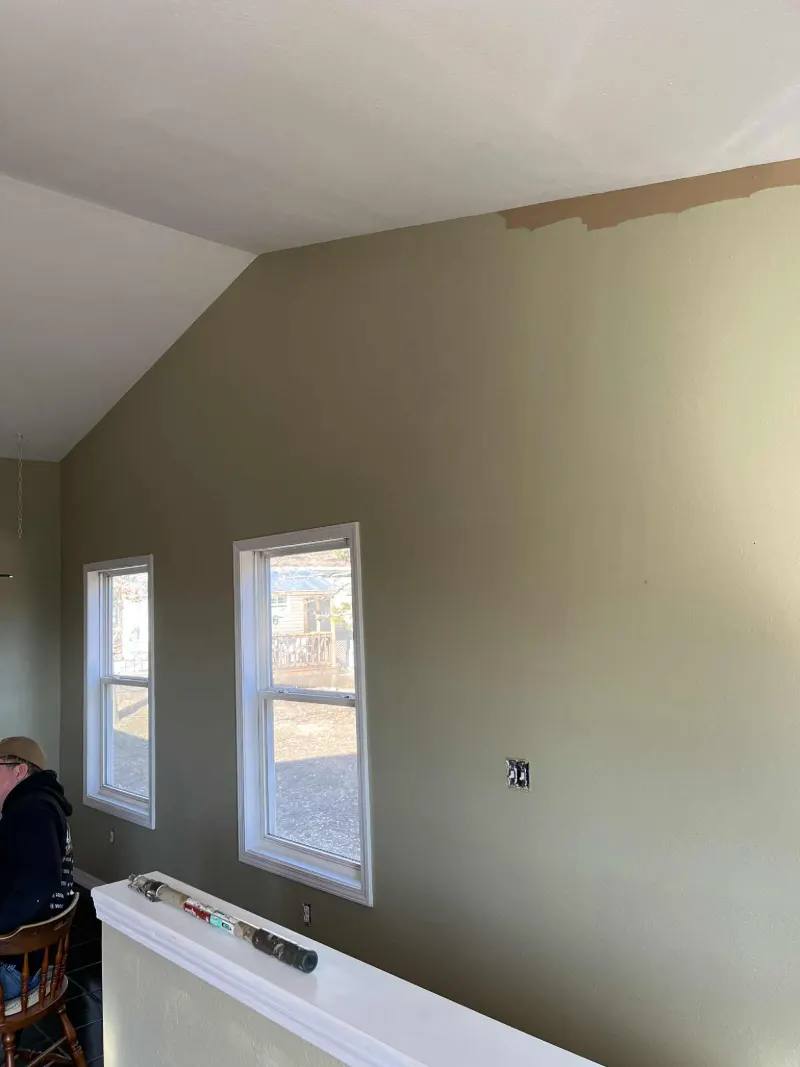
What about paint smell and fresh air in winter?
Take the smell seriously, but don't panic about it. The Environmental Protection Agency says levels of several organic compounds average two to five times higher indoors than outdoors, and its first piece of advice is simple: increase ventilation when you use products that give off VOCs, and follow the label. Here's how we do that when it's cold outside:
- Low-VOC or zero-VOC paint by default for walls and ceilings in occupied homes. Ask for the product name on your estimate and look it up. You should be able to read the VOC content on the product data sheet.
- Short, wide-open airing bursts instead of a window cracked all day. Ten minutes with a window open at each end of the house moves a lot of air without chilling the whole place.
- A box fan in the window of the room being painted, blowing out, with that room's door closed. That pulls fresh air in through the rest of the house and pushes the paint air outside.
- Run the bathroom and kitchen exhaust fans. They're the only mechanical exhaust most Denver houses have, and they help.
- Keep the furnace running at a normal temperature. Paint needs warmth to dry properly. The data sheet for one major brand's interior paint says not to apply it when the air or the surface is below 50°F, and it gives drying times at 77°F. Cold rooms dry slowly and can cause problems.
Anyone in the house with asthma, a respiratory condition or a new baby should ask their doctor about timing, and may want to stay elsewhere on the day their part of the house is painted. That's a conversation to have before the job, not during it.
How long until each room is back to normal?
There's a difference between dry and cured, and it decides when you can push the dresser back against the wall. Benjamin Moore puts it plainly: dry paint is no longer wet to the touch, while cured paint is fully hardened. Its guidance for walls is that they're usually dry within one to two hours, the room can be used lightly after 24 hours, and the paint takes about 30 days to cure.
| Milestone | Typical timing for latex wall paint | What it means for you |
|---|---|---|
| Dry to the touch | About 1 hour* | No more wet-paint signs, but don't lean on it |
| Ready for a second coat | About 2 hours* | Why a room can get two coats in one day |
| Light use of the room | About 24 hours | Sleep in it, walk through it, keep furniture off the walls |
| Furniture back against walls | 7 to 10 days | Benjamin Moore's guidance, so pieces don't stick or mark the finish |
| Fully cured, OK to scrub | About 30 days | Spot clean gently before then |
*From one manufacturer's data sheet, measured at 77°F and 50% relative humidity. Cooler or more humid rooms take longer.
Cabinets are slower. Benjamin Moore says they're often dry to the touch in two to four hours but shouldn't be used for two to three days, and they also take about 30 days to cure. If you're painting cabinets during a stay-at-home project, plan for the kitchen to be out of commission for longer. Our cabinet painting page walks through that schedule.
Kids, pets and working from home
Pets. Cats and dogs are curious about open paint cans, ladders and wet walls. Pick one closed room (usually a finished room or the basement) as the pet room for the day, and tell the crew which doors must stay shut. Wet paint on a tail travels farther than you'd think.
Kids. Paint their rooms early, keep the ladders and tools inside the work zone, and give them a room that isn't being touched that day. Most kids think the furniture-in-the-middle-of-the-room look is fun for about an hour.
Working from home. Tell us which room is your office and what hours you have calls. We paint it first or last, and we schedule the noisy work (furniture moves, sanding, patching) around your meetings when we can.
Older homes. If your house was built before 1978, ask about lead before anyone sands. Under the EPA's Renovation, Repair and Painting rule, disturbing more than 6 square feet of painted surface per room inside a pre-1978 home requires an EPA-certified firm and lead-safe work practices. Our lead-safe painting guide explains what that looks like day to day.
The night-before checklist
- Take pictures, mirrors, curtains and anything fragile off the walls and shelves in the first zone.
- Empty closets you want painted. Everything else can stay.
- Decide where the pet room and the work-from-home room will be.
- Clear a path from the front door to the first zone and tell us where to park.
- Set the thermostat to your normal daytime temperature, not a setback.
- Label the paint for touch-ups at the end, and keep it inside the house. Latex paint shouldn't freeze in a Colorado garage.
Does staying home change the price?
Not much. A lived-in house takes a little more time for furniture moves and daily cleanup than an empty one, and that shows up in the labor hours. The bigger cost drivers are square footage, ceilings, repairs and the number of colors. Our Denver painting cost guide has room and whole-house ranges with sources, and the interior painting page shows how we price and schedule interior work.
Winter is also when a lot of homeowners get interiors done, because exterior crews move indoors once it's too cold for siding. Painter Hotline's guide on why fall and winter work well for interior painting in Colorado covers the timing side in more detail.
Sources
Every number in this guide comes from the source listed. Checked November 3, 2026.
- Volatile Organic Compounds' Impact on Indoor Air Quality (updated June 23, 2026), U.S. Environmental Protection Agency.
- How to Clean and Maintain Freshly Painted Walls and Cabinets, Benjamin Moore.
- Ben Interior Paint, Matte (N624) technical data sheet: dry times at 77 F and 50% RH, 50 F minimum, Benjamin Moore.
- Lead: Renovation, Repair and Painting Program, U.S. Environmental Protection Agency.